Despite growing international recognition that reversing biodiversity loss requires transformative change, one of the greatest challenges remains translating research into action. This summer, TCforBE contributed to two major international science-policy forums, helping to shape discussions on how research, policy and society can work together to create more just and sustainable relationships between people and nature.
TCforBE Research Lead, Professor Valerie Nelson, represented the project at both the Transformative Change for Biodiversity Conference in Brussels and the World Biodiversity Forum in Davos, contributing insights drawn from the project's work and broader research on transformative change, citizen engagement and biodiversity governance.
Bringing research closer to policy
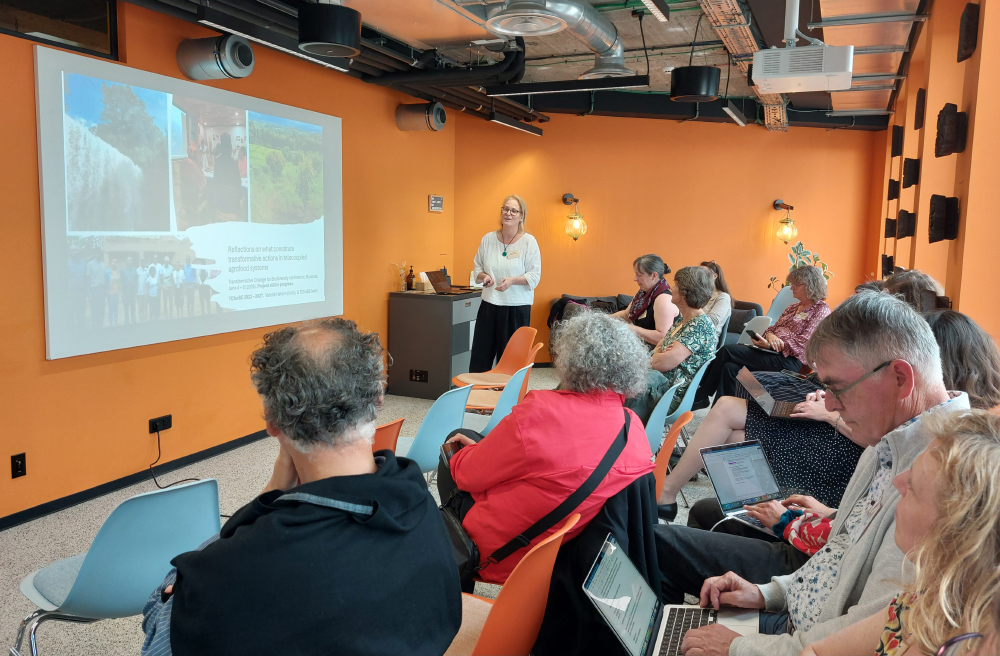
Held on 4–5 June, the Transformative Change for Biodiversity Conference brought together around 150 researchers, policymakers, financial organisations and civil society representatives from across Europe. The conference created a shared space to synthesise research, exchange ideas and explore practical pathways to accelerate transformative change for biodiversity. It was co-organised by nine Horizon Europe projects within the Transformative Change Cluster – TCforBE, BAMBOO, BIONEXT, BIOTraCes, CircHIVE, BioAgora, DAISY, PLANET4B and TRANSPATH.
The event focused on translating interdisciplinary research into actionable recommendations that can support major European policy agendas, including the EU Biodiversity Strategy and the European Green Deal, while also informing wider international biodiversity processes.
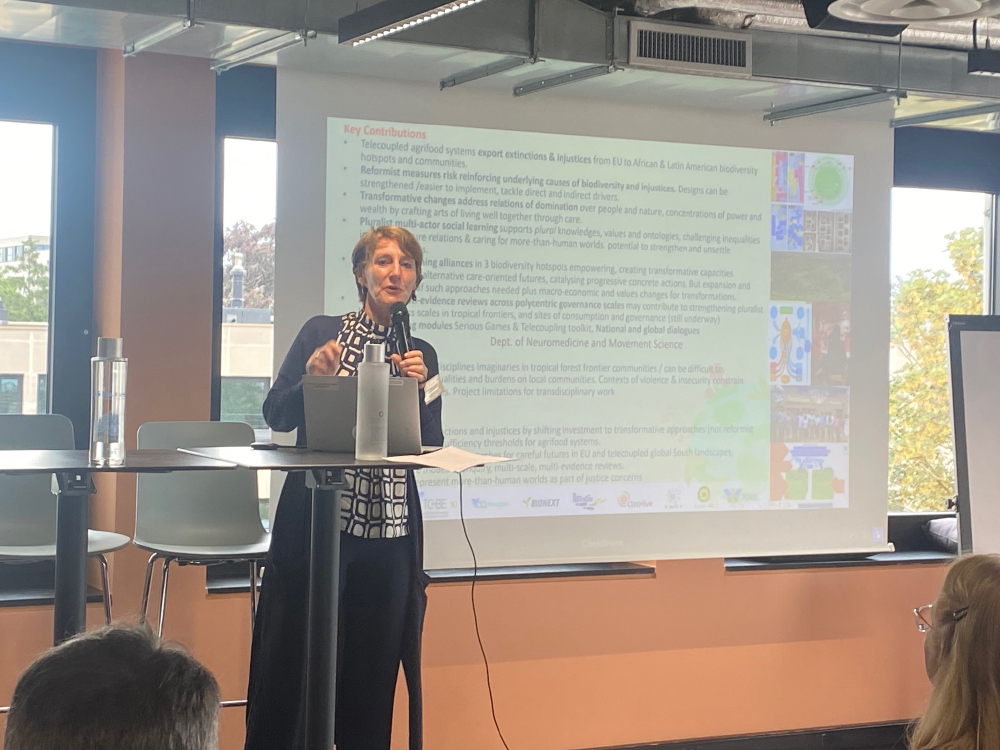
TCforBE project researchers presented work including a biodiversity-friendly scenario to feed the world by 2050, options for financing biodiversity transformations, and transformative pathways from producer and consumer sides of major commodity crop value chains in Kenya, Colombia and Cameroon.
TCforBE played a prominent role throughout the conference. Professor Nelson contributed presentations on multi-actor social learning and transformative innovations in globally connected agri-food systems, highlighting the importance of engaging with the deeper political, social and economic drivers of biodiversity loss. TCforBE PhD researcher Niall Readfern (Natural Resources Institute, University of Greenwich) discussed arts-based approaches for transformative change.
Reflecting on the conference, Professor Nelson noted that meaningful engagement between research projects and European policymakers remains challenging, even for projects adopting transdisciplinary approaches. She highlighted the conference as an important opportunity to bring together related projects, strengthen dialogue with policymakers and explore how research funders can better support work with genuinely transformative ambitions.
Exploring transformative change on a global stage
Later in June, Professor Nelson participated in the World Biodiversity Forum 2026 in Davos, Switzerland, where more than 1,000 participants from over 70 countries gathered under the theme Leading Transformation Together.
The forum addressed a pressing global challenge. Although countries adopted ambitious biodiversity targets through the 2022 Kunming-Montreal Global Biodiversity Framework, implementation has fallen short, increasing the need for approaches that can bridge scientific knowledge, policy and public engagement.
Professor Nelson's presentation, Critical reflections on emerging approaches to civic engagement for just and sustainable people–nature futures, explored ways of involving the public in biodiversity and nature decision-making in increasingly polarised societies. Specifically, the talk looked at two ways of public engagement: deliberative (focused on weighing evidence to reach a decision) and dialogic (focused on open discussion to build understanding). It also highlighted the need for social movements to contest current dominant ways of doing things, the role of creative arts and everyday practices and digital dimensions of engagement and contestation. The presentation also encouraged participants to reflect on how historical power structures continue to influence biodiversity governance and science-policy discussions while highlighting alternative, more relational ways of understanding connections between people and nature.
Contributing to a shared global agenda
Together, the transformative change conference and the World Biodiversity Forum demonstrated the growing recognition that scientific evidence is necessary but insufficient for addressing biodiversity loss. These efforts also demand collaboration across disciplines, sectors and societies, alongside greater attention to questions of equity, governance, participation and the underlying drivers of environmental change.
Through such contributions, TCforBE continues to help shape international conversations on transformative change, ensuring that research not only advances scientific understanding but also supports more equitable and effective pathways towards nature-positive futures.
Professor Valerie Nelson is based at the Natural Resources Institute at the University of Greenwich.